Dear Friends and Supporters, This Sunday afternoon, Mar. 14/23 at 2 p.m. on zoom is the second in a 3-part series of Study and Action Circles aimed at making the Ft. McMurray Tailings “Ponds” an issue in the upcoming Alberta provincial election. See the invitation below, including registration info/links.
See also the “backgrounder” hyperlink near the end of the invitation below for a few notes on how you can prepare for the Study and Action Circle.
Hope to see you on Sunday afternoon, Rod Olstad (he/him) Tailings Study and Action Circles Coordinator Edmonton Chapter, Council of Canadians
Dear Friends and Supporters, The Edmonton chapter of the Council of Canadians is excited to invite you to our three-part Study and Action Circle series where we will plan a people’s response to the challenge of cleaning up the toxic Athabasca tar sands tailing ponds and make this a provincial election issue. The study and action series will take place via Zoom and is a follow-up to the symposia series we held with Keepers of the Water in fall 2022.
These events will be held Sunday afternoons from 2-5 p.m. MST and will be an opportunity to learn more about the tailings ponds and to build community power in response to this massive public and environmental health hazard.
Dates and times:
February 26th 2-5 p.m.: This Study and Action Circle will take place via Zoom and focus on the past and present of tailings and the scientific and technical issues related to them.
March 12th 2-5 p.m.: This Study and Action Circle will take place via Zoom and focus on Indigenous Rights and Knowledge as they relate to the tailings issue.
April 2nd 2-5 p.m.: This Study and Action Circle will take place in-person (location TBD) and via Zoom and will focus on solutions to tailings and how those solutions can be part of a just transition.
How will we transition to a climate friendly economy and energy system? How can we cope with the dangers of the climate crisis while maintaining hope and taking action. Artists can help and young Edmonton artists are taking the lead!
Two groups are planning art events this summer that will explore the issues of climate change and visions of a better future.
Edmonton’s Climate Art Exhibition
Edmonton Youth for Climate is inviting Edmontonians to create drawings, poems, letters and any other art forms that speak of climate change and Edmonton’s Energy future. Submit digital art pieces to edmontonyouthforclimate@gmail.com and physical art pieces to Earth’s General Store, 9605 82 Ave.Edmonton. For up to date information, visit the Edmonton Youth for Climate Instagram site: https://www.instagram.com/edmontonyouthforclimate
Young Artists for Systems Change Symposium
Young Arts & Culture for Systems Change: A Creative Visioning Symposium will be a youth-driven one-day event, for any and all Albertans, taking place in Edmonton (and live streamed on zoom) on June 26th, 2022. The symposium will feature artists from different disciplines who will present or perform their work exploring the theme of what a “Just and Sustainable Energy Transition in Alberta”. This will be followed by a panel discussion, then a Q&A and a group activity.
When: June 26, 2022, 2PM Where: Nina Haggerty Centre for the Arts (225 118 Ave NW) Cost: Pay-What-You-Can To Register, email yacsc.ab@gmail.com
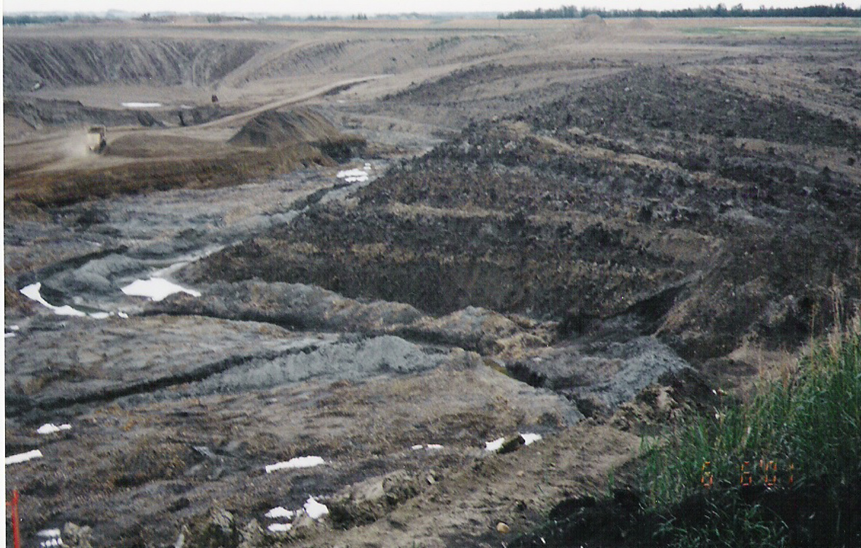
“Reclaimed” Sand and Gravel Strip Mine near Calahoo, northwest of Edmonton
by Ian Skinner and Mike Northcott, Onoway River Valley8 Conservation Association ( a Working Group of the Edmonton Chapter of the Council of Canadians)
May 25, 2022
On Feb 8, 2000 the Sturgeon County Subdivision and Development Appeal Board stated the following in their decision regarding strip mining: “The Board believes that mining operations within ½ mile of multi-lot subdivisions and 1 mile from the Hamlet of Calahoo would negatively impact the quiet, peaceful residential character of the area… The Board believes this to be an incompatible use within the community that would negatively interfere with the amenities of the neighborhood as well as materially interfere with or affect the use, enjoyment or value of neighboring parcels and on the lack of information on the possible impact of sand and gravel operations on the groundwater.” (Sturgeon County, 2000). The board considered that of one hundred and twenty-eight (128) notices sent out, sixty-nine (69) letters of objection were received. Considering that over 50% of notices were returned against this development, “The Board [was] in the opinion that the neighbors are not supportive of the application.” In this case, the Subdivision Development Appeal Board ultimately denied a permit for a gravel mining operation.
In April 2000, several residents proposed a bylaw amendment, which would have prohibited resource extraction within the Villeneuve Overlay Area (Sturgeon County, 2000). This amendment was not adopted. Instead, Sturgeon County Council placed a temporary moratorium on all development permits for resource extraction within the Villeneuve Overlay Area, and proposed an Area Structure Plan, which would guide future development in the region. Over 20 years later, concerns that were brought forward by residents are still being ignored.
There is no doubt that Alberta should make careful use of its natural resources, especially to supply the province’s own requirements. However, careful use is contradicted when government agencies aggressively promote the extraction of non-renewable resources before integrating environmental protection during the municipal planning and development stage. As a result, the protection of our water, air, and land seems to follow as an afterthought if considered at all. This is demonstrated in the Strategic Alignment Checklist of the ‘Sturgeon County Resource Extraction Regulatory Review final report (2021)’, which recommends that environmental stewardship is “not applicable”. If the purpose of the municipality is to foster the well-being of the environment, why is environmental legislation section 60 of the Municipal Government Act omitted at the earliest stages of land use planning and development?
Reports published by the Environment Conservation Authority on December 1971 described the ‘fairly obvious’ significant negative impacts of strip mining, where the most frequently expressed concern centered around water quality and quantity. Concerns also related to reducing waterway flow rates, disrupting groundwater flow patterns, endangering, wildlife habitat and lowering of aesthetic values were reported.
A “water body” is described in the Alberta Public Lands Act as the bed and shores all permanent and naturally occurring bodies of water, and all naturally occurring rivers, streams, watercourses and lakes and in the Alberta Water Act as any location where water flows or is present, whether or not the flow or the presence of water is continuous, intermittent or occurs only during a flood, and includes but is not limited to wetlands and aquifers. Given the ubiquity of groundwater-surface water exchange, it is more appropriate to view groundwater and surface water as a single source.
The Alberta Public Lands Act Section 54(1):“No person shall cause, permit or suffer… the existence on any public land of any excavation of any kind that is undesirable…, the doing of any act on public land that may injuriously affect watershed capacity, …and the disturbance of any public land in any manner that results or is likely to result in injury to the bed or shore of any river, stream, watercourse, lake or other body of water or land in the vicinity of that public land…” The text clearly describes the requirement to not cause or allow damage to waterbodies or land in the vicinity of that public land. Who is exempt?
The purpose of the Alberta Water Act is to ‘support and promote’ the conservation and management of water and the Alberta Environmental Protection and Enhancement Act is to ‘support and promote’ the protection, enhancement and wise use of the environment. Why are these purposes in these acts?
In research by The Pembina Institute, County Canada’s Natural Capital: Assessing the real value of Canada’s boreal ecosystems (2009) found that the total non-market value of boreal ecosystem services is 13.8 times greater than the net market value of boreal natural capital extraction. If we apply this calculation to (Sturgeon County sand and gravel extraction Resource Extraction Regulatory Review 2021 – $50 million natural capital extraction), the total non-market value of ecosystem services would equate to $690 million ($50 million x 13.8). This calculation doesn’t take previous extraction into account, and the non-market value of ecosystem services removed. With such high value given to ecosystem services, why wouldn’t resource management and land use decisions need to account for impacts on ecosystem services and the overall state of the regions ‘natural capital’?
In the 2019 Auditor General of Alberta Report: Alberta Environment and Parks (AEP) – Management of Sand and Gravel Pits, since prior to 2008 AEP’s reclamation, inspection, and enforcement processes are still inadequate, and so is the security. Key findings in 2019 conclude that AEP did not implement our recommendations to improve processes to inspect sand and gravel mines on public land, and to enforce reclamation requirements.
Why are our concerns still being ignored regarding the irreparable damage by aggregate strip mining activities to the natural functions of the Sturgeon River Watershed?
It has been felt that ignoring the environment in this manner has had a serious impact on the natural functions (non-recoverable environmental debt) of the Sturgeon River Watershed.
In correspondence with Alberta Municipal Affairs, “section 60 of the Municipal Government Act (MGA) assigns direction, control and management of water bodies (environmental protection) to municipalities”, “that no other legislation uses the same language in conferring authority” and “should a province wide need be identified to strengthen the role of municipalities in water resource conservation, further clarification of responsibilities may be necessary”.
We feel our governments have a great responsibility to the people they serve and need to ensure they conduct themselves in a transparent manner, abide by their own rules and laws, are inclusive, engage meaningfully with all stakeholders, and are held accountable for the decisions that they make that impact their residents today and future generations.
Do you have Defend Alberta Parks or Alberta Beyond Coal signs on your lawn? If you do, don’t take them down yet! These issues have not gone away. The Canadian Parks and Wilderness Society (CPAWS) has alerted us to concerns related to both the parks and coal issues. Click the links below to find out more.
The Federal Government is working on updated coal mining effluent regulations. The Province of Alberta has committed to enforcing these regulations after they have been finalized. Because of this, these regulations will have a real impact on our watersheds.
The Council of Canadians Edmonton Chapter joined other Alberta organizations in providing feedback on the proposed regulations. In short, the proposed regulations are not stringent enough to protect our watersheds from harmful effluents. We recommended lowering thresholds for pollutants, improving measurement and monitoring and implementing enforcement and penalties for exceeding thresholds.


 edmontoncouncilofcanadians.ca