The Slow and Ongoing Destruction of an Important Aquifer Northwest of Edmonton
The Edmonton Chapter stands with the Onoway River Valley Conservation Association in their 25 years long battle to protect the environmental integrity of the Sturgeon River Valley aquifer. This aquifer is delineated by the extensive sand and gravel deposits along the prehistoric Onoway River Valley pre-glacial channels found under the current Sturgeon River.
“Underground deposits of sand and gravel are the basic constituents of an aquifer. These formations naturally filter and store water that is then slowly released back into the surface water system; they are critical elements in the provision of environmental services essential to life.
As important as these sand and gravel deposits are to aquifers, they also have become valuable commodities, constituent parts in the manufacturing of cement and in providing base materials for roads and sidewalks. Though there are some innovative exceptions, virtually every building, road and sidewalk are built with significant amounts of sand and gravel.
Sand and gravel mining near the Sturgeon River in Sturgeon County and Lac St. Anne area, northwest of Edmonton, began in the 1950’s. Taken individually, these mines are of minimal environmental consequences.
However, as these mining operations expanded and began to mine deep below the local water table, negative impacts added up. Not only are the constituent parts of the aquifer being removed for profit, mining operations are also “de-watering” aquifers to access the sand and gravel deposits. These operations are now de-watering aquifers to facilitate mining 75 feet deep or more, well below the natural water table. Water licenses for as much as 250,000 cubic meters per day have been granted to these operations by Alberta Environment.
Available environmental reports show that a “cone of depression” 10 metres deep and 8 kilometres plus in radius exists under the major sand and gravel mining operation near Calahoo and Villeneuve, north west of Edmonton.
Residential water wells in the area are severely impacted to the point where rural household and farm water wells are no longer viable. Local rural residents now depend on water trucked in to secure water for household uses.
As de-watering lowers the water table, area lakes and other surface water bodies are negatively impacted. De-watering aquifers contributes to the declining levels of these lakes and other surface water bodies. With the permanent dismantling of sand and gravel aquifers, water has fewer places to go during high precipitation events, leading to an increase in probability of flooding events.
Though sand and gravel are now essential commodities for our communities, there are significant environmental costs to their profligate removal from the environment. There are innovative alternatives to sand and gravel that should be explored. The provincial government would be well advised to facilitate and encourage the development of such innovative alternatives, as healthy aquifers are also essential to life and our environment as a whole.
Rod Olstad
Edmonton Chapter-Council of Canadians
and Prairies-NWT representative to the National Council of Canadians Board.
LEAD Technologies Inc. V1.01
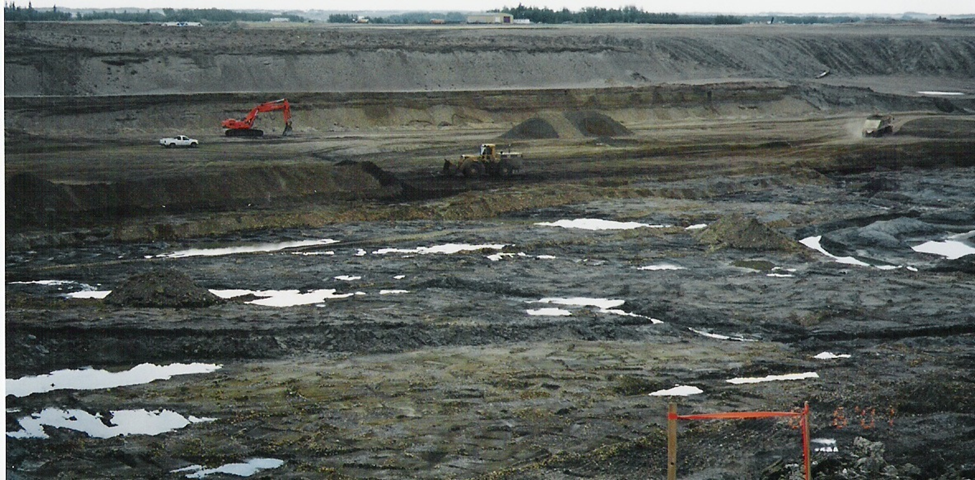
Strip mining well below the water table in the Villeneuve, Alberta area, just north west of Edmonton. This kind of mining requires dewatering the aquifer, which disrupts neighbouring land owners’ water wells often for many kilometres in radius in a “cone of depression”. This practise also disrupts surface water within the radius of the “cone of depression” due to the effects of hydro-stadic pressure.
Ukrainian Centre
11018 97 Street Northwest
Edmonton, AB T5H 2M9

June 7, 2026 at 1:00 – 5:00 PM (MDT)
The Council of Canadians Edmonton Chapter invites you to a a fun and relaxed gathering where you can meet organizations/groups that work to protect, conserve, preserve and restore the North Saskatchewan River Watershed.
Join us at the Ukrainian Centre on June 7, 2026 at 1:00 PM (MDT) to celebrate the amazing work being done to protect the North Saskatchewan River (NSR) Watershed. It’s a great chance to connect with others who care about our river, share stories, and enjoy some good company. Don’t miss out on this awesome community event!
This is a rare opportunity to mingle in-person with many North Saskatchewan River (NSR) Watershed conservation enthusiasts & experts and learn about:
• Dedicated work done to preserve & restore wetlands and tributaries that sustain the North Saskatchewan River
• Concerns about the substance that maintains life in the NSR watershed: H2O
• Opportunities to work with & support stewards of the NSR
This event is free for everyone and we will have light refreshments and snacks.
Registration
There is no need to register. Just come! However, if you do register, it will help us evaluate numbers and provide you with a reminder before the event
The Edmonton Chapter of the Council of Canadians invites you to join us at the following two events: No Co2 Pipelines Town Hall (May 13,2026, 6 PM – 8:30 PM) and A Celebration of Stewards of the North Saskatchewan River Watershed (June 7, 2026 at 1:00 – 5:00 PM)
No Co2 Pipelines Town Hall
Ukrainian Centre
11018 97 Street Northwest
Edmonton, AB T5H 2M9
Wednesday, May 13th – 6 PM – 8:30 PM
Join the Edmonton Chapter of the Council of Canadians and No CO2 Pipelines Albertato learn more about the upcoming taxpayer-funded CO2 pipeline in our province and how we can stop it!
This event will include an informative slide show about the pipeline and its risks. Speakers include representatives of Keepers of the Water and the National Farmers Union and a landowner along the route. There will be an opportunity to ask questions and discuss the issue.
Afterwards, participate in a cool screen-printing activity where you will be able to print No Co2 Pipeline patches.
Why Oppose the Co2 Pipeline
The Oil Sands Alliance is planning to construct a massive, multi-billion-dollar Carbon Capture, Utilization and Storage (CCUS) project across northeast Alberta, paid for by taxpayers.
This project includes a CO2 pipeline run through regular Albertans’ backyards, with massive safety and economic risks along the route. These include a new and largely untested technology, and the danger of a leak or rupture which can harm people and animals within a 20 kilometre “hazard zone.”
Join No CO2 Pipelines Alberta on Wednesday, May 13, for an engaging Edmonton town hall to learn about the issue.
Register on Eventbrite to get reminder before the Town hall.
A Celebration of Stewards of the North Saskatchewan River Watershed
Ukrainian Centre 11018 97 Street Northwest Edmonton, AB T5H 2M9
June 7, 2026 at 1:00 – 5:00 PM (MDT)
The Council of Canadians Edmonton Chapter invites you to a a fun and relaxed gathering where you can meet organizations/groups that work to protect, conserve, preserve and restore the North Saskatchewan River Watershed.
Join us at the Ukrainian Centre on June 7, 2026 at 1:00 PM (MDT) to celebrate the amazing work being done to protect the North Saskatchewan River (NSR) Watershed. It’s a great chance to connect with others who care about our river, share stories, and enjoy some good company. Don’t miss out on this awesome community event!
This is a rare opportunity to mingle in-person with many North Saskatchewan River (NSR) Watershed conservation enthusiasts & experts and learn about:
• Dedicated work done to preserve & restore wetlands and tributaries that sustain the North Saskatchewan River
• Concerns about the substance that maintains life in the NSR watershed: H2O
• Opportunities to work with & support stewards of the NSR
This event is free for everyone and we will have light refreshments and snacks.
The Edmonton Chapter stands with the Onoway River Valley Conservation Association in their 25 years long battle to protect the environmental integrity of the Sturgeon River Valley aquifer. This aquifer is delineated by the extensive sand and gravel deposits along the prehistoric Onoway River Valley pre-glacial channels found under the current Sturgeon River.
Strip mining sand and gravel in the Villeneuve, Alberta area, just north west of Edmonton
Alberta’s strip-mining methods for Oil Sands, Sand, Gravel and Coal create huge monetary advantage for governments and industries, creating an unfair disadvantage for the legal right of watersheds1 and household users. Laws are designed to protect fundamental rights and prevent harm. Violating the purpose of the law can negate those protections. Acting against the spirit of the law can create unfair advantages for some and disadvantages for others, as laws are in place to protect public safety and promote the common good. Omitting laws or any action that contravenes laws has serious consequences for all Albertans now, especially future generations.
Alberta’s (1968) Municipal Government Act (MGA) s. 169 states “subject to every other act, a municipal council has the control and management of the public highways, roads, streets, lanes, alleys, bridges,rivers, streams, watercourses, lakes and other bodies of water within the municipality.”
In Alberta’s current MGA,s.169 was replaced with s.60 where the phrase -‘bodies of water’ is included, and the text states, “subject to any other enactment2, a municipality has the direction, control and management of bodies of water within the municipality, including the air space above and the ground below.”
Why were these laws created?
Environmental Stewardship has a long history among our founding juridical traditions and has been recognized by the Supreme Court of Canada as a “fundamental value” and “a public purpose of super-ordinate importance. This clearly identifies a municipal imposed legal obligation to safeguard the well-being of the environment which includes environmental stewardship, provisions for environmental protection and conservation. A legal obligation is a duty or responsibility on governments and others by law, to avoid acts or omissions that cause harm. A commitment to ethical principles and social responsibility is crucial for ensuring environmental decisions are just and sustainable.
Decisions made behind closed doors and/or in-camera can lead to strip mining land-use bylaws that are not in the overall public interest/ common good. Mediation and/or mitigation involving confidentiality agreements can be confidential, potentially allowing corporations to avoid public scrutiny and the establishment of harmful precedents. Mediation can lead to compromises that weaken environmental regulations or standards, especially if parties are more focused on reaching a monetary settlement than protecting the environment. Environmental mitigation is the process by which industry and/or developers apply measures to avoid, minimize or compensate (confidentiality agreements) for the identifiable adverse effects and negative environmental impacts resulting from undesirable activities creating environmental harm. The rule of mitigation identifies breach of trust; a trustee does not intend to uphold the law to take reasonable steps to avoid undesirable harm.
Governments and others that are prioritizing the commodification of water create an ongoing unfair disadvantage to Alberta’s watersheds and household users. Commodifying water and destroying the natural hydrological functions within watersheds purposely ignores the purpose and spirit of laws.
John Aston, Executive Director of the Alberta Sand and Gravel Association (ASGA) lobbied Hon. Jason Nixon, MLA in 2020 to remove environmental impact assessments (EIA’s) from sand and gravel strip mining activities. In just six weeks the ASGA ensured EIA’s are no longer legislated and mandatory for sand and gravel strip mining activities.3 Why was this unfair method approved?
Municipal codes of conduct for councillors to uphold laws and human rights have recently been eliminated by Ric McIver, past Minister of Municipal Affairs and no longer legally enforceable. Our current Minister of Municipal Affairs Dan Williams indicates he was employed by the sand and gravel industry and supports resource extraction.4 What does this mean for the natural functions of watersheds, and our top priority legal right as household water users?
In 2021, Sturgeon County’s Resource Extraction Regulatory Review (RERR) deliberately omitted environmental stewardship for resource extraction land-use within the Sturgeon River Watershed5. This despite the 2022 to 2023 Villeneuve-Calahoo Groundwater Monitoring Report identifying a 10 metre decline in the water table and an 8 km plus cone of depression in a ground water body aquifer extending under private property associated with sand and gravel strip mining activities6 Underground trespass occurs when someone enters or interferes with the subsurface of another person’s property (i.e. interfere with the continued flow of groundwater) without permission, adversely affecting the landowner’s use or enjoyment of the property.
Conflict of interest can affect professional duties in decision-making causing an unfair disadvantage for stakeholders. When brought to the attention of Sturgeon County, that Sturgeon County, their consultant Hydrogeological Consultants Ltd and Heidelberg Materials are identified as members of the Alberta Sand and Gravel Association (ASGA), changes were made to the ASGA website and membership is no longer identified.
Strip mining activities in watersheds within or adjacent to water bodies must be described cumulatively, as inherently dangerous and/or ultrahazardous, carrying consequences and substantial risk of permanent environmental harm to North America’s watersheds, such as the headwaters found in the eastern Rocky Mountains. Compromising the interconnectedness of natural systems has far-reaching and detrimental consequences. Disrupting these connections leads to a cascade of negative impacts, injuriously affecting everything from local environments, watershed capacity, to global climate patterns.
Decades of disinformation by governments and others, misrepresenting past or existing facts and relevant legislation at the earliest stage of municipal land-use plans and bylaws, identifies decades of irreversible harm to watersheds and household users’ rights. Willfully ignoring the legal right of watersheds and the legal right of household users is the act of intentionally avoiding knowledge or information, especially when that knowledge would lead to an uncomfortable or inconvenient truth requiring action.
Systematically, decades of governments and others ongoing failure to integrate and enforce conservation and protection legislation at the earliest stage of municipal land-use bylaws indicates government sponsored environmental harm (when government actions, or lack thereof, have caused environmental harm), and constructive fraud (when a person or entity’s gain unfair advantages over another’s by deceitful or unfair methods).
Why are our watersheds and household water use under threat?
Footnotes
The legal right of watersheds identified in law is part of section 54(1) of the Alberta Public Lands Act. That section prohibits (no person shall, cause, permit or suffer) various activities on or that adversely affects the province’s public lands, to include but not limited to the bed or shore of all permanent and naturally occurring water bodies (i.e. groundwater aquifers), adjacent land and/or injuriously affects watershed capacity. ↩︎
Subject to other acts/enactments – i.e. Land Stewardship Act, Purposes of Act 1(1); Water Act, Purpose, Definition water body, Household Purposes s.21, Priority of household users s.27, Issuance of approvals s.38; and Public Lands Act, Application of the Act s.2, Title to beds and shores, etc. s.3, Acquisition by prescription s.4, and Prohibitions s.54
In May 2020, the Alberta Court of Appeal ruled that sand was a mineral would require an environmental impact assessment (EIA) if a mine would be digging up more than 45,000 tonnes per year. This decision was in response to a request from a member of the Alexis Nakota Sioux First Nation that Wayfinder, a company proposing to mine silica sand in their watershed, be ordered to submit an EIA.
The report states that “The objective of the RERR is to seek a more competitive balance between economic, social, health, and environmental outcomes ….” (Sturgeon County’s Resource Extraction Regulatory Review P. 6), However, the review undervalued the legal right of household users of water and the real service values of aquatic ecosystems. continues to create permanent unrecoverable environmental debt and a cascade of negative irreversible consequences. ↩︎